Truckload capacity is tightening ahead of 2026. Learn what shippers should watch as regulations, carrier exits, and rate volatility reshape freight markets.
Find out how OverDrive can help you navigate 2026.
Truckload Capacity Is Becoming More Fragile
Recent market data highlights that the U.S. truckload market is shifting toward a more fragile capacity environment heading into 2026.
-
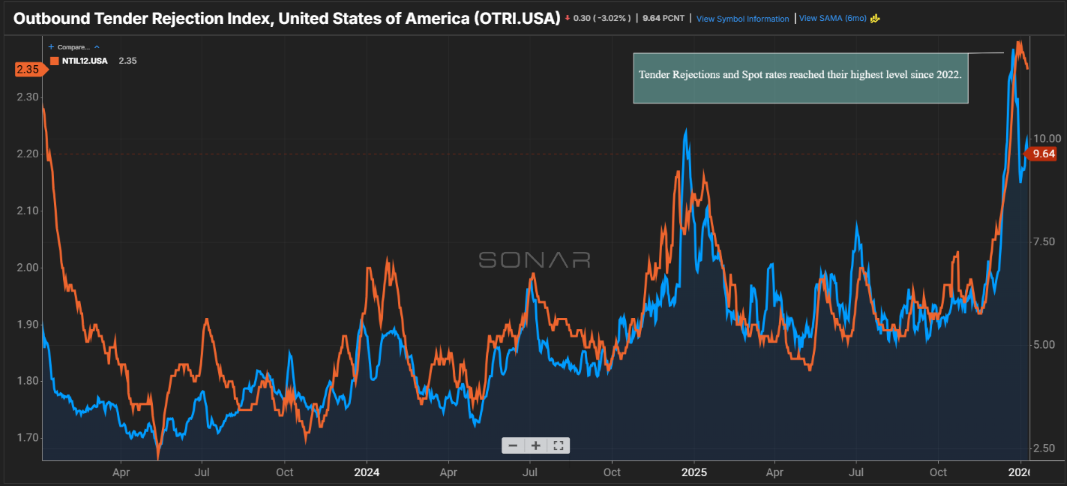
Spot and contract rates remain subdued. Truckload spot rates showed only modest year-over-year growth in late 2025, while contract rates ticked up only slightly — contributing to a market where shippers have enjoyed good tender acceptance and generally easy access to capacity.
-
However, the supply side is tightening. A combination of continued carrier attrition, heightened regulatory enforcement on driver credentials (especially non-domiciled CDL and English proficiency rules), and rising operating costs is reducing available capacity. This is making the carrier base more sensitive to even small market changes.
-
Capacity exits and driver pool constraints are looming risks. One major provider warns that if demand spikes or capacity losses accelerate, we could see freight rate volatility in 2026 — with spot rates potentially overtaking contract rates and carriers feeling greater pressure to improve profitability.
For shippers, this signals a potential shift from the relative ease of capacity seen over the past couple of years toward a market where carrier leverage can return quickly if conditions tighten.
Regulatory Forces Are Reshaping Market Structure
Two major regulatory themes are converging as we approach 2026:
-
Driver Credential Enforcement: New and stronger enforcement on non-compliant CDL holders is expected to reduce the available driver pool and squeeze capacity further — potentially hastening structural change in the U.S. carrier market.
-
Broker Financial Responsibility Rules: A major FMCSA rule taking full effect January 16, 2026, will fundamentally tighten how freight brokers must maintain and report their financial responsibility — especially around the long-standing $75,000 surety bond requirement.
What the FMCSA Bond Rule Means for Brokers (and Shippers)
Under the updated FMCSA rules:
-
Brokers must maintain a minimum of $75,000 in liquid financial security (surety bond or trust) at all times.
-
If a broker’s bond or trust balance drops below the required amount, they now have just seven business days to restore it or face automatic suspension of operating authority — a much tighter timeframe than past practice.
-
BMC-85 trust funds — the common alternative to surety bonds for many brokers — are now required to consist only of cash or quick-convert assets and be held with federally regulated institutions. This may force many brokers to re-structure or replace their financial instruments.
These changes close previous loopholes that once allowed brokers to operate with depleted or questionable financial backups. The FMCSA’s intent is to protect carriers and shippers by reducing the risk of unpaid freight bills and financial instability within the broker community.
Market Conditions and Margin Pressure
The backdrop for these regulatory shifts is a trucking market that has been under pressure:
-
Long-standing margin compression for brokers continues as carriers demand higher spot payouts and shippers hold contract rates tight.
-
Brokers facing tight margins and new bond enforcement may see increased consolidation, exit of weaker firms, or strategic repositioning — all of which could indirectly affect capacity and pricing in the broader freight ecosystem.
What Shippers Should Watch
For shippers engaged in over-the-road truck freight:
✔ Capacity isn’t loosening any further. Although it’s stable now, structural pressure points could lead to less slack and more volatility in 2026.
✔ Plan for rate transitions. Spot rate strength relative to contract rates may grow as carriers’ economics tighten.
✔ Brokers’ financial health matters. The FMCSA bond changes are designed to weed out undercapitalized intermediaries — but the transition could temporarily disrupt capacity and relationships in certain lanes.
✔ Stay flexible. Shippers with diversified carrier panels, forward pricing strategies, and proactive contract terms are better positioned as markets shift.
How OverDrive Logistics Is Helping Shippers Navigate What’s Ahead...
As the truckload market moves toward a more fragile capacity balance and tighter regulatory oversight, shippers will benefit most from partners who bring financial stability, carrier depth, and disciplined execution to the table. That is where OverDrive Logistics plays a critical role.
What OverDrive Logistics Provides
-
Stable, compliant brokerage operations: OverDrive maintains strong financial controls and compliance practices aligned with upcoming FMCSA enforcement, reducing risk and ensuring continuity for shipper partners. OverDrive has been under the same ownership since 1998. With a $250,000 Broker Bond, we are prepared for the latest changes in Broker governance.
-
Vetted carrier networks: With long-standing relationships across small, mid-sized, and asset-based carriers, OverDrive helps shield shippers from sudden capacity disruptions tied to carrier or broker exits. We also utilize the latest in fraud-prevention technology to ensure your freight is protected.
-
Balanced contract and spot strategies: As spot and contract dynamics evolve, OverDrive helps shippers structure freight programs that protect service levels while managing cost exposure.
-
Market intelligence and proactive planning: Instead of reacting to volatility, OverDrive works with customers to anticipate capacity shifts, regulatory impacts, and seasonal inflection points before they disrupt supply chains. Let us help you gain deeper insight and plan for disruptions before they impact your business.
- Industry-leading technology enhanced with the latest AI tools: OverDrive is a long-term leader in using the best vetted technology in the Logistics industry. But we aren't stopping there. Today, we use cutting-edge Artificial Intelligence (AI) tools to improve our speed, creativity, and accuracy while still serving you personally.
Recommended Next Steps for Shippers
To stay ahead of potential market tightening in 2026, shippers should consider:
✔ Reviewing carrier and broker relationships to ensure partners are financially sound and operationally resilient
✔ Stress-testing routing guides and backup capacity for key lanes
✔ Reassessing contract vs. spot exposure as capacity sensitivity increases
✔ Engaging in forward-looking planning conversations rather than waiting for disruption to force change
Looking Forward
The freight market entering 2026 is not signaling crisis — but it is signaling change. Capacity is thinner beneath the surface, regulatory pressure is rising, and structural discipline will matter more than ever.
Shippers that partner with experienced, well-capitalized logistics providers and plan proactively will be best positioned to maintain service, control cost, and avoid surprises as conditions evolve.
If you have questions about how OverDrive can be that partner for your shipping needs, we're ready to talk.
Use the meeting calendar below to schedule an introduction, call us at (800) 866-7282, or email: customersales@overdrivelogistics.com.