Weekly U.S. trucking market update covering market rates, capacity, and key industry trends—plus what it means for shippers and how to stay ahead.
The Force is… shifting.
The U.S. truckload market is showing clear signs of tightening. Diesel remains elevated, rates are firming, and regulatory + legal pressures are beginning to reshape how freight moves across the galaxy (…or at least across the U.S.).
A major disturbance in the Force to watch: the pending Supreme Court case Montgomery v. Caribe Transport, which could redefine liability across the brokerage model.
For shippers, the message is clear: this is not the time to “set it and forget it.” Stay alert—because the market is evolving quickly.
Fuel Costs
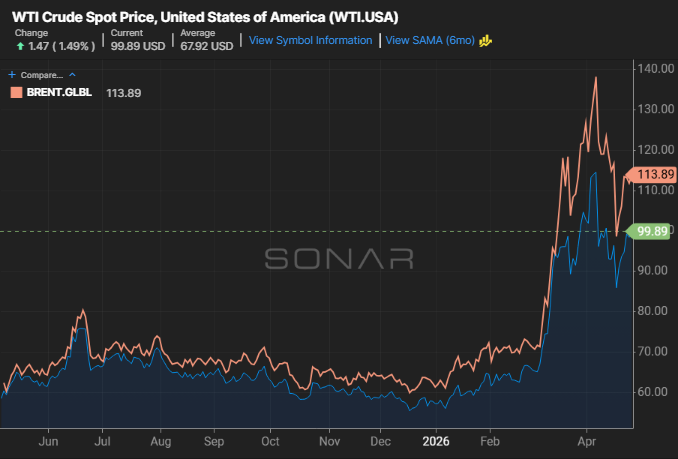
Fuel continues to be the dominant force driving cost.
Diesel prices remain significantly higher than last year, with regional volatility still wide—especially on West Coast lanes. While prices have softened slightly week-over-week, they’re still firmly in “cost pressure” territory.
Shipper impact:
Fuel surcharges aren’t going anywhere. Expect continued upward pressure on:
- Refrigerated freight (constant cooling = constant burn)
- Long-haul lanes
- California and coastal markets
Think of fuel as the “anti-gravity” of your transportation budget—it’s always pulling costs upward.
Freight Rates
Rates are firming across both spot and contract markets.
Capacity is tightening gradually due to:
- Carrier exits over the past 18–24 months
- Rising operating costs
- Seasonal demand (especially for food and beverage)
Reefer is where the action is heating up as produce season ramps.
One interesting trend is the widening gap between Tender Rejections vs. Spot Rates. Both Dry Van and Reefer Tender Rejections are down from 1 year highs:
- Dry Van Tender Rejection Rate: 12.76%, down 14% from late March, but almost 3 times the rate in early May 2025.
- Reefer Tender Rejection Rate: 14.32%, down 38% from February's high, but still almost twice the rate from 1 year ago.
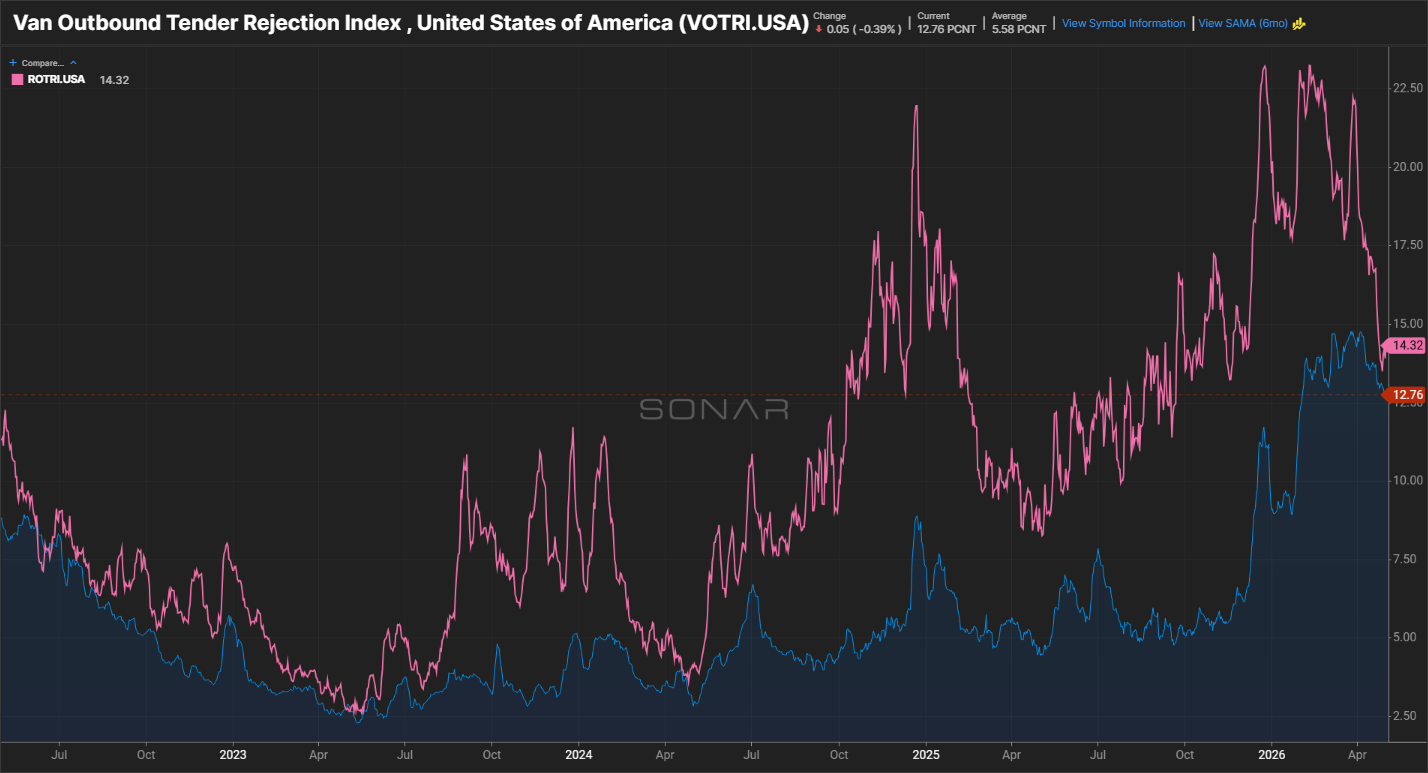
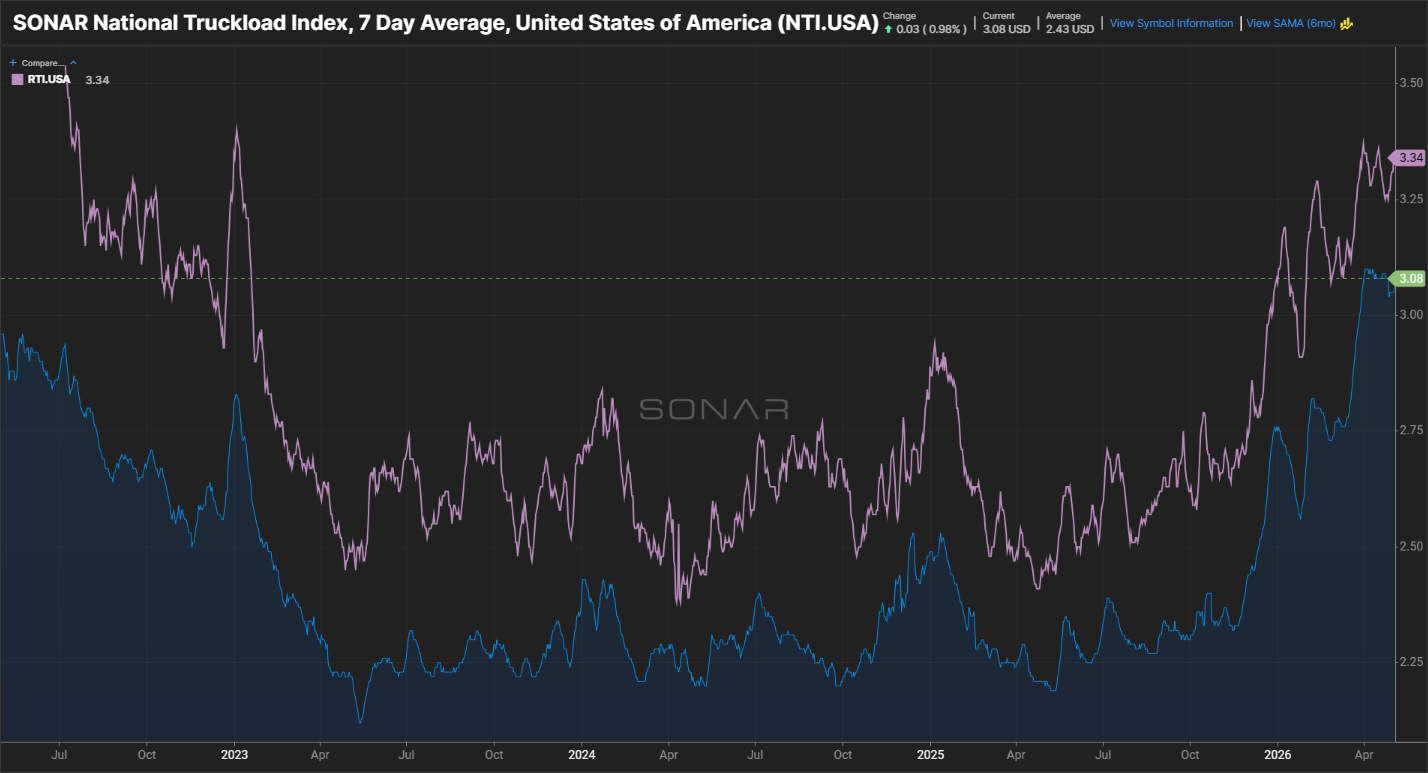
Although tender rejections are down, rates aren't. The rates being paid by shippers continue to remain stuck at the highest levels since April 2022.
Shipper impact:
- Lock in reefer capacity early—don’t wait for peak season chaos
- Review routing guides and identify backup carriers now
- Expect more volatility on key lanes
In short: this is no longer a “buyer’s market.” The balance of power is evening out.
Innovation & Technology - These ARE the Droids you're looking for...
Autonomous trucking is no longer a future concept—it’s entering early-stage commercialization, with real capital, real freight, and real networks forming around it.
Major Fleet Commitments & Scale Is Coming Fast
The biggest recent headline: a strategic partnership between autonomous developer Aurora and refrigerated carrier Hirschbach Motor Lines to deploy up to 500 autonomous trucks starting in 2027.
- These trucks will run on high-volume freight lanes, particularly across the Sun Belt
- Aurora’s “Driver-as-a-Service” model allows carriers to own equipment while outsourcing the driving system
- The network is already active—Aurora has logged 800,000+ autonomous miles and 2,000+ loads with Hirschbach
Why it matters:
This is the clearest signal yet that autonomous trucking is moving from pilot programs to scaled fleet deployment.
Autonomous trucking has officially crossed the line from “interesting” to “inevitable.”
The combination of:
- Real freight movement
- Large-scale fleet commitments (500+ trucks)
- Billions in capital investment
- Favorable regulatory environments
…means the industry is entering the early scaling phase.
You’re not managing a fleet of robot trucks tomorrow—but the lanes you rely on today are already being mapped for autonomy.
Regulation, Legal Risk & Compliance
All eyes are on Montgomery v. Caribe Transport.
At issue:
- Can brokers be held liable for accidents involving carriers they hire?
- Does federal law (specifically the Federal Aviation Administration Authorization Act) shield brokers from state negligence claims?
Why it matters:
- A ruling against brokers could fundamentally reshape freight procurement
- Carrier selection standards will likely tighten further
- Costs could rise as legal exposure is priced into rates
- Shippers may face increased scrutiny on how freight is awarded
This case has the potential to shift the balance of power across the industry in a very real way.
What is OverDrive Logistics doing to prepare?
At OverDrive, we have already implemented strict carrier vetting rules, processes, and techonolgy. We don't take carrier integrity and safety lightly. By leveraging the latest industry technology, we only work with carriers we know we can trust. Your freight moves on our ultra-secure network of partners.
What Shippers Should Watch
- Diesel trends (especially regional spikes)
- Reefer capacity tightening into peak season
- Spot rate volatility on core lanes
- The outcome of Montgomery v. Caribe Transport
- Ongoing regulatory enforcement impacting driver supply
Final Thought
This isn’t a market in crisis—but the pressure is building.
Higher fuel, firmer rates, tighter compliance, and potential legal shifts are all converging at once. The added uncertainty from Montgomery v. Caribe Transport is something the industry hasn’t fully priced in yet.
The shippers who succeed won’t rely on luck—they’ll rely on preparation:
- Strong broker relationships
- Flexible procurement strategies
- A serious focus on compliance and vetting
Because in this market… hope is not a strategy.
May the 4th be with your freight network!