Bi-Weekly U.S. trucking market update covering market rates, capacity, and key industry trends—plus what it means for shippers and how to stay ahead.
Does Your Freight Broker’s Carrier Vetting Process Protect You?
This week's market report focuses on a major story that happened last week in the logistics industry. On July 23rd, a Dallas, TX jury hit C.H. Robinson with a $604 Million verdict as the result of a fatal collision involving a driver from a carrier they contracted with for one of their shippers. How does this kind of punitive ruling impact shippers? What does this mean for the freight broker industry in general? What's next? The article below dives into the ruling and how it will impact carrier, broker, and shipper behavior and decision making for years to come.
$604 Million Verdict Shows That Brokerage Size Does Not Eliminate Shipper Risk
A Dallas County jury awarded $604 million in damages following a 2021 crash involving a motor carrier selected by C.H. Robinson. The collision killed three people and injured two others. Plaintiffs argued that the carrier had a history of federal safety alerts and that the driver told both the carrier and C.H. Robinson that he was too sick to continue driving. The jury found the driver, carrier and C.H. Robinson negligent, assigning most of the financial responsibility to the brokerage. C.H. Robinson disputes the allegations and is appealing the verdict.

What the Jury Decided Against C.H. Robinson
A Dallas County, Texas, jury returned an approximately $604 million advisory verdict arising from a March 2021 crash involving motor carrier Lupus Superior. The crash occurred on Interstate 20 in Mississippi, killing three motorists and injuring two others. The jury found the driver, Lupus Superior and C.H. Robinson negligent.
- Total damages: The jury awarded approximately $604 million to the crash victims and their families.
- Direct allocation of fault: The jury assigned 45% of the fault to the driver, 32% to Lupus Superior and 23% directly to C.H. Robinson.
- Additional responsibility for the driver: The jury reportedly determined that the driver was acting as a borrowed employee of C.H. Robinson and was performing a transportation mission that benefited the brokerage. This finding could make C.H. Robinson responsible for the driver’s 45% share in addition to its own 23% share—potentially placing 68% of the verdict on C.H. Robinson.
- Basis of the case: Plaintiffs argued that C.H. Robinson selected Lupus Superior despite prior unsafe-driving alerts and permitted the shipment to continue after the driver reportedly told both the carrier and C.H. Robinson that he was too sick to keep driving.
- C.H. Robinson’s position: The company denies that it acted negligently, emphasizing that Lupus Superior had completed nearly 270 loads for its customers and held a “Satisfactory” FMCSA safety rating when selected. C.H. Robinson has announced that it will appeal.
The key distinction is that the jury did not simply hold C.H. Robinson responsible for choosing the carrier. It also reportedly found that C.H. Robinson exercised enough control over the transportation assignment for the driver’s actions to be attributed to the brokerage. However, this remains an advisory jury verdict, not the final outcome of the case. Post-trial proceedings and the expected appeal could reduce, overturn or otherwise modify the verdict.
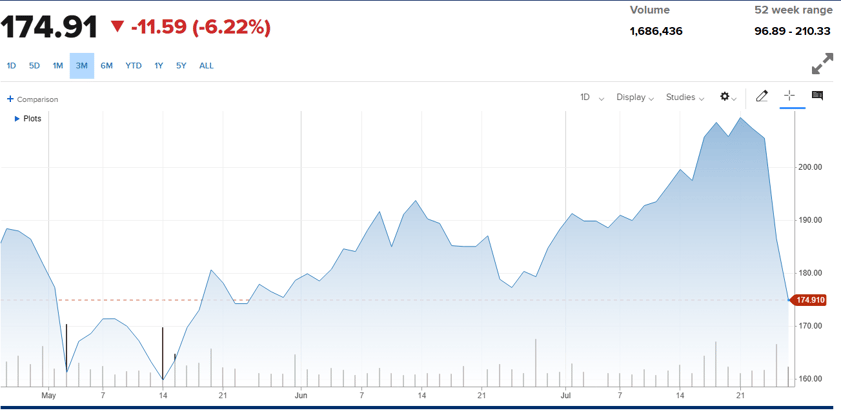
As a result of the verdict, C.H. Robinson's stock price has dropped 14.88% since the ruling.
What This Means for Shippers
Using a major brokerage is not a complete liability shield. Large brokers such as C.H. Robinson, TQL and other national providers may have extensive compliance systems, technology and insurance, but their size does not guarantee that every carrier assigned to a shipment will meet an acceptable safety standard. The verdict demonstrates that courts and juries may examine the actual carrier-selection process rather than simply relying on the brokerage’s reputation or market position.
Shippers may also be drawn into negligent-selection lawsuits. On May 14, 2026, the U.S. Supreme Court ruled in Montgomery v. Caribe Transport II that federal transportation law does not automatically prevent state-law negligent hiring claims against freight brokers. Industry guidance following the ruling warns that shippers may face similar exposure and may no longer be able to rely on federal preemption as an early defense.
A carrier’s federal authority and “Satisfactory” rating may not be enough. C.H. Robinson stated that the carrier had successfully handled nearly 270 loads and held a Satisfactory FMCSA safety rating. Plaintiffs, however, presented evidence of other safety alerts. This creates a difficult environment in which a carrier can be legally authorized and federally rated as satisfactory but still be challenged after an accident.
Contractual indemnification may not eliminate the disruption. A broker may agree to defend and indemnify its shipper customer, but a catastrophic accident can still expose the shipper to litigation costs, document requests, depositions, reputational damage and disputes over whether the contract or insurance policy covers the claim. TIA’s post-Montgomery guidance specifically notes that brokers commonly defend and indemnify shippers and expects that exposure to expand.
Operational control creates additional risk. Shippers should be careful about directly controlling drivers, prescribing how a carrier performs transportation or pressuring a broker or carrier to continue a shipment despite fatigue, illness, hours-of-service concerns or unsafe conditions. The more operational control a shipper appears to exercise, the easier it may become for plaintiffs to argue that the shipper shares responsibility.
Recommended Actions for Shippers
Shippers should require their brokers—not only smaller providers, but also major national brokerages—to document:
- The carrier qualification and continuous-monitoring process used for every load.
- Which safety ratings, insurance deficiencies, authority issues or inspection patterns automatically disqualify a carrier.
- Whether carrier qualifications are checked only during onboarding or again when each shipment is tendered.
- The broker’s contingent auto liability, general liability and umbrella insurance limits.
- Clear defense and indemnification provisions covering negligent carrier selection.
- Restrictions against unauthorized rebrokering or double brokering.
- Procedures allowing a driver or carrier to stop a shipment without penalty when illness, fatigue or unsafe conditions arise.
This verdict does not establish that large brokerages are inherently less safe than smaller brokers, and the $604 million award remains subject to appeal. It does establish that brokerage size, brand recognition and purchasing power do not relieve a shipper from conducting reasonable due diligence.
Shippers should evaluate brokers based on the transparency and consistency of their carrier-selection practices—not simply their annual revenue, shipment volume or name recognition.
How OverDrive Logistics Reduces Carrier-Selection Risk
At OverDrive Logistics, we believe a carrier’s federal operating authority or “Satisfactory” safety rating should never be the only factor used to determine whether that carrier is qualified to haul a customer’s freight.
A carrier may have active authority, valid insurance and an acceptable federal rating while still showing warning signs that require a closer look. That is why we use a more comprehensive carrier-vetting process designed to evaluate the carrier’s actual safety history, operating practices and overall risk profile.
We use carrier-screening and fraud-prevention technology to support our qualification process, verify carrier identities and reduce the risk of unauthorized rebrokering and cargo theft. We also use real-time tracking and communication tools to maintain visibility throughout the shipment.
Most importantly, carrier qualification is not simply a one-time onboarding exercise. We apply scrutiny to every shipment and evaluate whether the selected carrier is appropriate for the specific freight, lane, equipment requirements and customer expectations.
More Than a Safety Rating
An FMCSA safety rating provides useful information, but it does not always tell the full story. A carrier may meet the minimum legal requirements and still fail to meet OverDrive’s standards. When the available information raises concerns, we are willing to decline that carrier rather than expose our customers, their freight or the motoring public to unnecessary risk.
The OverDrive Difference
Some brokers focus primarily on the size of their carrier network. At OverDrive, we focus on the quality, safety and suitability of the carrier assigned to each individual shipment.
Our approach includes:
- Human review supported by carrier-screening technology.
- Shipment-specific carrier selection rather than automated matching alone.
- Fraud and identity verification during carrier onboarding.
- Real-time shipment tracking and communication.
- Live, U.S.-based operational support available 24/7.
We do not believe carrier selection should be based solely on price, availability or a single safety rating. Our responsibility is to make informed decisions using the best information available and to select carriers that meet both regulatory requirements and OverDrive’s own standards.
Bottom Line
At OverDrive Logistics, we do not assume a carrier is safe simply because it has operating authority, insurance or a Satisfactory federal rating.
We look deeper.
By reviewing fraud indicators, history, equipment suitability and prior performance, we provide our customers with a more thorough and responsible carrier-selection process.
Capacity matters, but safety, carrier quality and accountability matter more.
If you're unsure about your current broker's carrier vetting process, contact us today to see how we can help!
Prepared by OverDrive Logistics for customer education and market awareness.
Source references include FreightWaves, TIA, DAT, SONAR, CNBC, CCJ Digital, and industry reporting.